Buy pgx.eu ?
We are moving the project
pgx.eu .
Are you interested in purchasing the domain
pgx.eu ?
domain@kv-gmbh.de · 0541-91531010
Buy pgx.eu ?
What are rational floating-point numbers?
Rational floating-point numbers are numbers that can be expressed as a ratio of two integers, where the numerator and denominator are both integers. These numbers can be represented as fractions or decimals, and they can be accurately represented in a floating-point format. Rational floating-point numbers are a subset of all floating-point numbers, which also include irrational numbers and non-numeric values like infinity and NaN (not a number). In computer programming, rational floating-point numbers are often used to represent quantities that can be precisely expressed as fractions, such as monetary values or measurements. **
What is the nominated floating point representation?
The nominated floating point representation is a standardized way of representing real numbers in a computer system. It typically consists of a sign bit, an exponent, and a fraction, and is used to store and manipulate floating point numbers in a binary format. This representation allows for a wide range of values to be stored and manipulated with a consistent level of precision, making it suitable for a wide range of computational tasks. The most commonly used standard for floating point representation is the IEEE 754 standard, which defines formats for single precision (32-bit) and double precision (64-bit) floating point numbers. **


Similar search terms for Floating-point
Top-Angebote
Products related to Floating-point:
-
What's the Point of Philosophy? (DK What's the Point of?)Travel down the road of wisdom to discover how to think about a series of philosophical problems, how to defend your opinions on them, and how to evaluate the opinions of others. Why is philosophy important? What's so great about it? Take a leap into the world of philosophy and discover questions about life, the universe, and human behaviour that great thinkers have pondered throughout history, and which are still being asked today. Philosophical ideas affect our day-to-day lives in ways that you might not expect. But understanding these ideas can be daunting - even for adults! If you want to learn how to argue the case for animal rights, why the concept of equality has many sides, or even what the theories are about why humans exist at all, What's the Point of Philosophy? is the perfect place to start. Put your thinking cap on and get ready to explore:- A variety of fascinating topics reveal pivotal questions in philosophy that are still discussed today. - Timeline spreads illustrate major schools of thought, and the women and men who developed them. - Clear, accessible text makes the book appealing for readers of all ages. - Uncoated paper gives a vintage feel to the book which perfectly complements the illustrator's style. This fascinating philosophy book is a unique way to get kids to begin thinking critically about the world around them, and showcases the many ways in which philosophy has changed the world, one crazy idea at a time, and it is guaranteed to inspire, surprise, amuse, and entertain everybody who picks it up. By slowly unraveling arguments to unpack complex theories, What's the Point of Philosophy? allows you to connect with ideas in a new and exciting way. If you never stop asking 'why?', this is the book for you9,99 £*Shipping: 2,99 £Secure redirect to the provider
-
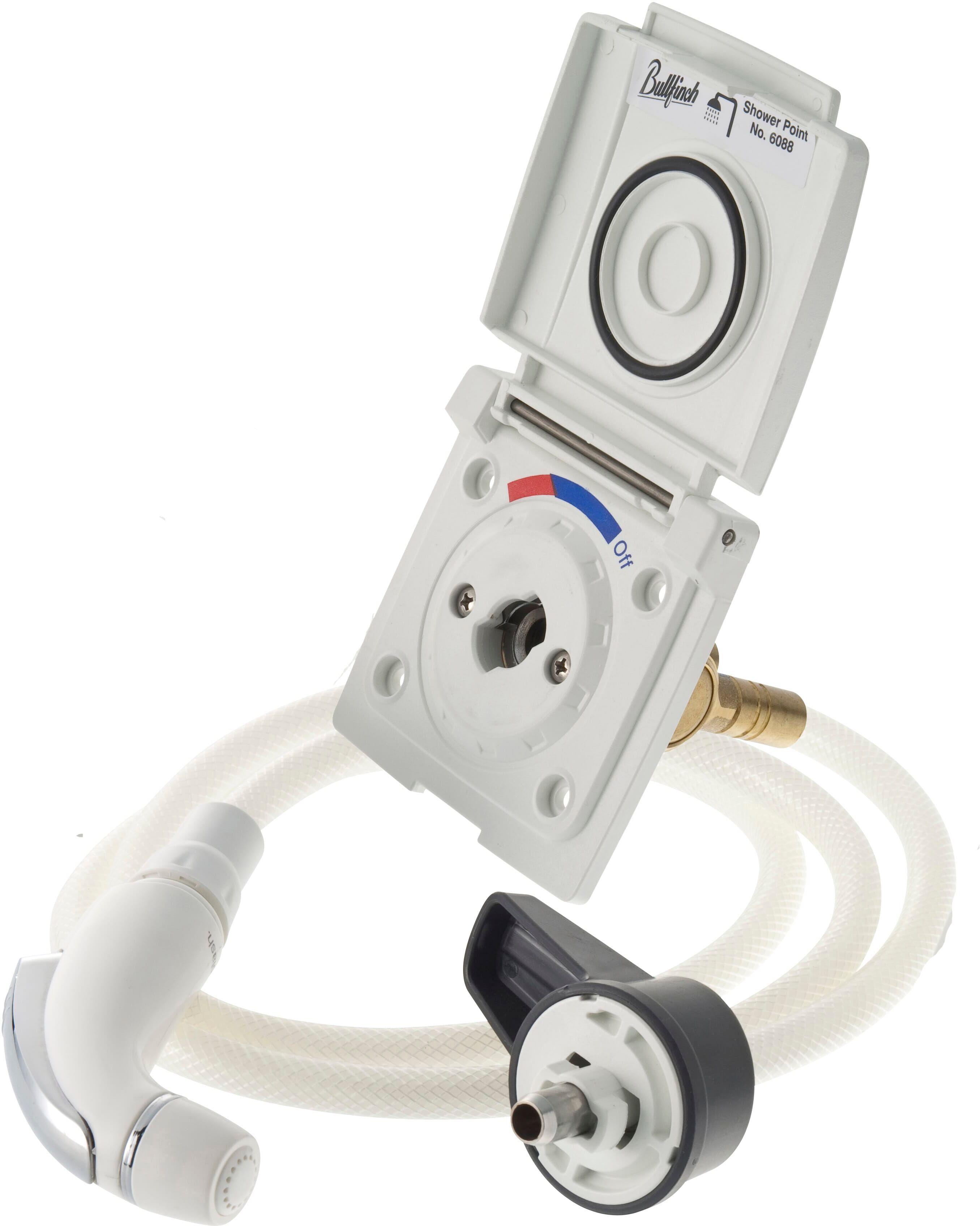
Bullfinch External Shower PointBullfinch External Shower Point – Convenient and Secure Outdoor Shower Solution The Bullfinch External Shower Point is a compact, lightweight, and stylish solution for adding an outdoor shower to your caravan, motorhome, or campervan. Complete with a shower head assembly, 1.5m shower hose, and fixing screws, this innovative design connects to your unit’s existing hot and cold water supplies, offering convenience and flexibility. Featuring push-and-turn activation for enhanced security, water flows only when the shower head assembly is inserted and locked in place. The swivel head with a fixed spray pattern and lever control provides a high flow rate for a comfortable showering experience. Key Features and Benefits69,42 £*Shipping: 5,00 £Secure redirect to the provider
-
Bullfinch Electric Outlet PointBullfinch Electric Outlet Point – Reliable and Stylish Power Solution for Caravans The Bullfinch Electric Outlet Point is a compact, lightweight, and highly reliable solution for providing outdoor power connections in caravans, motorhomes, and camping setups. Engineered with IP55 protection, it offers robust defense against water and dirt ingress when the plug is inserted, ensuring safe and reliable operation in outdoor environments. Designed for durability and ease of use, this electric outlet point features an innovative and attractive design that blends seamlessly with your caravan’s exterior. Its simple installation process requires a 105mm cutter and includes 4 fixing screws for quick and hassle-free setup. Key Features and Benefits32,34 £*Shipping: 5,00 £Secure redirect to the provider



-
What is the difference between fixed-point and floating-point representation?
Fixed-point representation uses a fixed number of digits to represent both the integer and fractional parts of a number, while floating-point representation uses a variable number of digits to represent the same. Fixed-point representation is limited in terms of range and precision, while floating-point representation allows for a wider range and higher precision. Floating-point representation is more flexible and can handle a wider range of values compared to fixed-point representation. **
-
How precise are floating-point numbers in Java?
Floating-point numbers in Java are not always precise due to the way they are stored in memory. This can lead to rounding errors and inaccuracies when performing calculations with decimal numbers. It is important to be cautious when using floating-point numbers for critical calculations that require high precision. To achieve more precise calculations, Java provides the BigDecimal class which allows for arbitrary-precision arithmetic. **
-
What is the difference between fixed-point format and floating-point format?
Fixed-point format is a number representation system where the position of the decimal point is fixed, and the number of digits before and after the decimal point is predetermined. Floating-point format, on the other hand, allows the position of the decimal point to float, enabling a wider range of values to be represented with varying levels of precision. In fixed-point format, the precision is fixed, while in floating-point format, the precision can vary based on the magnitude of the number being represented. Floating-point format is commonly used in scientific and engineering applications where a wide range of values and precision is required. **
-
How should one solve the normalized floating-point representation?
To solve the normalized floating-point representation, one should first understand the format of the normalized floating-point representation, which typically consists of a sign bit, a mantissa, and an exponent. Then, one should convert the given decimal number into binary and determine the sign, mantissa, and exponent. After that, normalize the binary representation by shifting the decimal point and adjusting the exponent accordingly. Finally, convert the normalized binary representation into the desired floating-point format, taking into account the sign, mantissa, and exponent. **


What are underflow and overflow in floating point numbers?
Underflow occurs when a floating point number is too small to be represented within the range of the floating point format, leading to a loss of precision and potentially resulting in a value of zero. Overflow, on the other hand, occurs when a floating point number is too large to be represented within the range of the floating point format, leading to a loss of precision and potentially resulting in an infinite or "not a number" (NaN) value. Both underflow and overflow can lead to inaccuracies in calculations and should be carefully handled in numerical computations. **
How do floating-point numbers differ from real numbers?
Floating-point numbers are a subset of real numbers that are used to represent approximate values in computing. Unlike real numbers, floating-point numbers have a fixed precision and range, which means they can only represent a finite number of values within a certain range. Real numbers, on the other hand, include all possible values on the number line, including irrational and transcendental numbers. Floating-point numbers are used in computer systems to perform calculations efficiently, but they can introduce rounding errors due to their limited precision. **
Top-Angebote
Products related to Floating-point:
-
Furniture Classics Blue Point Oak & Metal Floating Open Back Display StandThis bookshelf appears to float within its champagne frame, while actually being solid as a rock on metal supports. Five oak shelves in a soft grey provide gorgeous storage for books, or use it as an etagere to display your treasures.1225,49 $*Shipping: 0,00 $Secure redirect to the provider
-
Apple Complete Guide to Natural Vitamins by Lizzie Streit - Paperback Nutrition Guide - Food & Supplements - Adult Non FictionA practical guide to natural vitamins, written by a registered dietitian, this paperback book helps readers understand which vitamins and minerals the body needs and how to get them through everyday food. It blends nutrition science with realistic strategies, making it an approachable reference for anyone wanting to boost their diet, support their immune system, and build healthy habits at home. The book covers every essential vitamin and mineral, explaining what each nutrient does, how deficiencies develop, and which medical conditions or life stages can increase the risk of falling short. It prioritizes natural food sources, listing where to find each nutrient, rather than focusing solely on supplements.9,99 £*Shipping: 2,99 £Secure redirect to the provider
-
What's the Point of Philosophy? (DK What's the Point of?)Travel down the road of wisdom to discover how to think about a series of philosophical problems, how to defend your opinions on them, and how to evaluate the opinions of others. Why is philosophy important? What's so great about it? Take a leap into the world of philosophy and discover questions about life, the universe, and human behaviour that great thinkers have pondered throughout history, and which are still being asked today. Philosophical ideas affect our day-to-day lives in ways that you might not expect. But understanding these ideas can be daunting - even for adults! If you want to learn how to argue the case for animal rights, why the concept of equality has many sides, or even what the theories are about why humans exist at all, What's the Point of Philosophy? is the perfect place to start. Put your thinking cap on and get ready to explore:- A variety of fascinating topics reveal pivotal questions in philosophy that are still discussed today. - Timeline spreads illustrate major schools of thought, and the women and men who developed them. - Clear, accessible text makes the book appealing for readers of all ages. - Uncoated paper gives a vintage feel to the book which perfectly complements the illustrator's style. This fascinating philosophy book is a unique way to get kids to begin thinking critically about the world around them, and showcases the many ways in which philosophy has changed the world, one crazy idea at a time, and it is guaranteed to inspire, surprise, amuse, and entertain everybody who picks it up. By slowly unraveling arguments to unpack complex theories, What's the Point of Philosophy? allows you to connect with ideas in a new and exciting way. If you never stop asking 'why?', this is the book for you9,99 £*Shipping: 2,99 £Secure redirect to the provider
-
What are rational floating-point numbers?
Rational floating-point numbers are numbers that can be expressed as a ratio of two integers, where the numerator and denominator are both integers. These numbers can be represented as fractions or decimals, and they can be accurately represented in a floating-point format. Rational floating-point numbers are a subset of all floating-point numbers, which also include irrational numbers and non-numeric values like infinity and NaN (not a number). In computer programming, rational floating-point numbers are often used to represent quantities that can be precisely expressed as fractions, such as monetary values or measurements. **
-
What is the nominated floating point representation?
The nominated floating point representation is a standardized way of representing real numbers in a computer system. It typically consists of a sign bit, an exponent, and a fraction, and is used to store and manipulate floating point numbers in a binary format. This representation allows for a wide range of values to be stored and manipulated with a consistent level of precision, making it suitable for a wide range of computational tasks. The most commonly used standard for floating point representation is the IEEE 754 standard, which defines formats for single precision (32-bit) and double precision (64-bit) floating point numbers. **
-
What is the difference between fixed-point and floating-point representation?
Fixed-point representation uses a fixed number of digits to represent both the integer and fractional parts of a number, while floating-point representation uses a variable number of digits to represent the same. Fixed-point representation is limited in terms of range and precision, while floating-point representation allows for a wider range and higher precision. Floating-point representation is more flexible and can handle a wider range of values compared to fixed-point representation. **
-
How precise are floating-point numbers in Java?
Floating-point numbers in Java are not always precise due to the way they are stored in memory. This can lead to rounding errors and inaccuracies when performing calculations with decimal numbers. It is important to be cautious when using floating-point numbers for critical calculations that require high precision. To achieve more precise calculations, Java provides the BigDecimal class which allows for arbitrary-precision arithmetic. **
Similar search terms for Floating-point
-
Bullfinch External Shower PointBullfinch External Shower Point – Convenient and Secure Outdoor Shower Solution The Bullfinch External Shower Point is a compact, lightweight, and stylish solution for adding an outdoor shower to your caravan, motorhome, or campervan. Complete with a shower head assembly, 1.5m shower hose, and fixing screws, this innovative design connects to your unit’s existing hot and cold water supplies, offering convenience and flexibility. Featuring push-and-turn activation for enhanced security, water flows only when the shower head assembly is inserted and locked in place. The swivel head with a fixed spray pattern and lever control provides a high flow rate for a comfortable showering experience. Key Features and Benefits69,42 £*Shipping: 5,00 £Secure redirect to the provider
-
Bullfinch Electric Outlet PointBullfinch Electric Outlet Point – Reliable and Stylish Power Solution for Caravans The Bullfinch Electric Outlet Point is a compact, lightweight, and highly reliable solution for providing outdoor power connections in caravans, motorhomes, and camping setups. Engineered with IP55 protection, it offers robust defense against water and dirt ingress when the plug is inserted, ensuring safe and reliable operation in outdoor environments. Designed for durability and ease of use, this electric outlet point features an innovative and attractive design that blends seamlessly with your caravan’s exterior. Its simple installation process requires a 105mm cutter and includes 4 fixing screws for quick and hassle-free setup. Key Features and Benefits32,34 £*Shipping: 5,00 £Secure redirect to the provider
-
Cornerstone Press Make Me Well: The Truth About the Wellness Industry, Supplements, and Personalised Health by Xand van TullekenIn a world of endless wellness advice, learn how to make smarter decisions about your health with the empowering new book from doctor and broadcaster Xand Van Tulleken. Drawing on original reporting, expert insight and real-world case studies, he explores: The truth about supplements and vitamins ― what works and what doesn’t The rise of at-home blood testing and personalised health plans How wearable technology (fitness trackers, sleep trackers, smartwatches) shapes our behaviour The promises and pitfalls of consumer genomics and DNA testing Why the line between healthcare and the wellness industry has become blurred There has never been a more confusing time to try to be healthy. From supplements and blood testing to wearable technology and consumer genomics, the modern wellness industry promises better energy, performance and longevity. But how much of it is science, and how much is marketing? In his groundbreaking book, Make Me Well, Xand van Tulleken investigates the new Wild West of the wellness industry, offering a clear, evidence-based guide to navigating today’s most popular health trends. With practical advice and accessible science, Make Me Well will help you cut through misinformation, avoid unnecessary costs, and make informed decisions about your physical and mental wellbeing. If you’ve ever wondered which health trends are worth your time and money, this is your essential guide to modern wellness.12,99 £*Shipping: 2,99 £Secure redirect to the provider
-
Uplift Essentials Skin Rejuvenation Freezing Point Beauty Instrument Skin Rejuvenation Freezing Point Beauty InstrumentTransform your daily skincare regimen with an advanced clinicalgrade treatment that restores clarity and radiance to your complexion. The DPL Skin Rejuvenation Freezing Point Beauty Instrument combines structural light technology with comforting...209,97 $*Shipping: 0,00 $Secure redirect to the provider
-
What is the difference between fixed-point format and floating-point format?
Fixed-point format is a number representation system where the position of the decimal point is fixed, and the number of digits before and after the decimal point is predetermined. Floating-point format, on the other hand, allows the position of the decimal point to float, enabling a wider range of values to be represented with varying levels of precision. In fixed-point format, the precision is fixed, while in floating-point format, the precision can vary based on the magnitude of the number being represented. Floating-point format is commonly used in scientific and engineering applications where a wide range of values and precision is required. **
-
How should one solve the normalized floating-point representation?
To solve the normalized floating-point representation, one should first understand the format of the normalized floating-point representation, which typically consists of a sign bit, a mantissa, and an exponent. Then, one should convert the given decimal number into binary and determine the sign, mantissa, and exponent. After that, normalize the binary representation by shifting the decimal point and adjusting the exponent accordingly. Finally, convert the normalized binary representation into the desired floating-point format, taking into account the sign, mantissa, and exponent. **
-
What are underflow and overflow in floating point numbers?
Underflow occurs when a floating point number is too small to be represented within the range of the floating point format, leading to a loss of precision and potentially resulting in a value of zero. Overflow, on the other hand, occurs when a floating point number is too large to be represented within the range of the floating point format, leading to a loss of precision and potentially resulting in an infinite or "not a number" (NaN) value. Both underflow and overflow can lead to inaccuracies in calculations and should be carefully handled in numerical computations. **
-
How do floating-point numbers differ from real numbers?
Floating-point numbers are a subset of real numbers that are used to represent approximate values in computing. Unlike real numbers, floating-point numbers have a fixed precision and range, which means they can only represent a finite number of values within a certain range. Real numbers, on the other hand, include all possible values on the number line, including irrational and transcendental numbers. Floating-point numbers are used in computer systems to perform calculations efficiently, but they can introduce rounding errors due to their limited precision. **
* All prices are inclusive of VAT and, if applicable, plus shipping costs. The offer information is based on the details provided by the respective shop and is updated through automated processes. Real-time updates do not occur, so deviations can occur in individual cases. ** Note: Parts of this content were created by AI.